
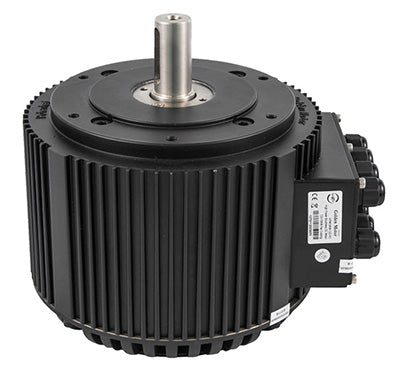
Pick a BLDC motor for your EV conversion by the power it has to hold for minutes at a time (cruising, climbing, pushing a hull), not by the peak number on the box. As a starting point, 3kW suits light karts and small utility builds, 5kW covers small boats and lighter carts, 10kW is the common pick for buggies, motorcycles and 18 to 26 ft boats, and 20kW is for heavy boats and bigger vehicles. Go liquid-cooled when the motor works hard for long stretches or lives in a closed compartment, and look at an axial flux motor when you want a lot of torque without a gearbox.
The rest of this guide shows how to check that starting point against your own vehicle, so you don't end up with a motor that overheats or a controller and battery that can't feed it.
The Golden Motor BLDC motor lineup at a glance
These are the figures published on each product listing. Where a listing doesn't give a number, the cell says so; we'd rather leave it blank than guess.
| Motor | Model | Voltages | Rated power | Peak power | Speed (rpm) | Rated / peak torque | Weight | Cooling |
|---|---|---|---|---|---|---|---|---|
| 3kW BLDC motor | HPM3000B | 48V, 72V | 2-3kW | 6kW | 3000-5000 | 10 / 25 Nm | 7.3 kg air, 8 kg liquid | Air or liquid |
| 5kW BLDC motor | HPM5000B | 48V, 72V, 96V, 120V | 3-7.5kW | Not listed | 2000-6000 (customizable) | Not listed | 11 kg air, 11.35 kg liquid | Air (fan) or liquid |
| 10kW BLDC motor | HPM-10KW | 48V, 72V, 96V, 120V | 8-20kW | Not listed | 2000-6000 (customizable) | Not listed | 17 kg air, 17.7 kg liquid | Air or liquid |
| 20kW BLDC motor | HPM-20KW | 72V, 96V, 120V, 144V | 20-25kW | 50kW | 3200-6000 | Not listed | 39 kg | Liquid only |
| GMX Hypertorque 7kW (axial flux) | HTM 7kW | 72V | 7kW | 18kW | 1950 rated / 3800 max | 45 / 110 Nm | 15 kg | Natural cooling |
| GMX Hypertorque 11kW (axial flux) | HTM11KW | 72V | 11kW | 28kW | 2500 rated / 4300 max | 60 / 160 Nm | 18 kg | Natural cooling |
All of these are rated IP65. The HPM motors list efficiency at 91% (5kW and 10kW) or over 90% (3kW and 20kW), and the GMX motors at over 90%.
A note on the HPM rated-power ranges: the 5kW and 10kW listings give a range instead of one number. Don't plan your build around the top of that range. Each listing links a performance data sheet and curve for each voltage, and that's where you see what the motor actually makes at a given rpm and current. Our BLDC motor technical parameters page has the parameter table as well.
Continuous vs peak power: the number that matters
Every motor has two power figures that mean very different things.
- Rated (continuous) power is what the motor can make for as long as you like without overheating, given its cooling. This is what you size to.
- Peak power is what it can make for a short burst: launching from a stop, the steep part of a hill, getting a boat onto plane. The GMX listings put a number on "short": max phase current is allowed for 30 seconds.
A quick example from the table. The GMX 11kW is rated at 11kW but peaks at 28kW. That peak is great for punchy acceleration in a kart or buggy, but if your vehicle needs 15kW just to hold cruising speed, the motor will be running above its rating the whole time and heat will build until something gives.
If you're replacing a gas engine, keep in mind that engine horsepower is a peak figure, measured at full throttle near redline. 1 HP is about 0.75kW, so a 10kW electric motor is roughly 13 HP continuous, plus a much higher peak, with full torque available from zero rpm. That's why the EZ-IB inboard kits use a 5kW motor to replace engines up to 12 HP and an 8kW motor for 12 to 20 HP engines. Electric continuous power and gas peak power don't compare one-to-one.
Voltage: 48V vs 72V vs 96V and up
Higher voltage doesn't automatically mean more power. What it changes is current, and current is what heats wires, connectors, controllers and battery BMS boards.
Power is voltage times current, so for the same 10kW:
| Pack voltage | Current at 10kW (before losses) |
|---|---|
| 48V | about 208A |
| 72V | about 139A |
| 96V | about 104A |
In real builds the number runs higher once you count losses. For a 48V 10kW motor working at full power we plan on roughly 230 to 260A at the battery. Cutting that current (by a third at 72V, by half at 96V) is the main reason we steer heavy boats and bigger vehicles toward 72V or 96V.
Voltage also sets top speed. Each HPM motor is wound for the voltage version you order, and its rpm scales with the voltage it sees. A 72V motor will run on 48V, but at lower rpm. The 20kW is offered in 72V and up only, and both GMX motors are 72V.
The rule the factory gives us: motor, controller and battery voltage should match. A 72V motor goes with a 72V controller and a 72V pack. Running it on a lower-voltage system only costs you speed, but never put a 72V motor on a 96V controller to "get more out of it."
RPM, torque and gearing
Torque and rpm are tied together by power:
Torque (Nm) = Power (W) x 9.549 / rpm
Check it against the 3kW: 3,000W at 3,000 rpm works out to about 9.5 Nm, which lines up with its 10 Nm rated torque. Most of these motors are rated somewhere in the 2,000 to 5,000 rpm range, which is much faster than a wheel or a propeller needs to turn. So almost every conversion needs a reduction (chain and sprockets, belt and pulleys, or a gearbox) to trade that rpm for torque at the wheel or shaft.
Here's how to rough out a ratio for a wheeled vehicle:
- Work out wheel rpm at your target top speed. A 22 in diameter tire travels about 69 in (1.75 m) per turn. At 40 mph (about 17.9 m/s) it turns roughly 610 rpm.
- Pick the motor rpm you want at that speed. Use a figure inside the motor's speed range from its data sheet, not the absolute maximum.
- Divide. 4,000 motor rpm / 610 wheel rpm is about 6.5:1.
Boats follow the same logic. Diesel prop shafts typically turn 950 to 1,800 rpm, while the HPM motors make their rated power at around 3,200 to 5,000 rpm. That usually means a reduction of about 3:1 to 4:1, or a smaller prop. Run the motor well below its rated speed and you get less power out of it, not the same power at lower rpm. If you're doing a boat, the motor bearings are radial, so you also need a separate thrust bearing between a flexible coupling and the stern tube. Our sailboat build with a BLDC motor shows a customer's 48V 10kW conversion (it was built on the older VEC controller).
You'll see "kV" (rpm per volt) on hobby motor specs. Golden Motor publishes rpm ranges and per-voltage data sheets instead, so use those.
How to size the motor to your vehicle (rough estimates)
There's no substitute for running the numbers on your own build, but you can get close with basic physics. Treat these as estimates for picking a size, not as a speed or range promise.
The power needed to keep a vehicle moving is roughly:
- Climbing: total weight (kg) x 9.81 x grade x speed (m/s)
- Rolling resistance: total weight (kg) x 9.81 x rolling coefficient x speed (m/s). The coefficient is around 0.015 for tires on pavement and higher on dirt or grass.
- Air drag: the power it takes grows with the cube of speed. Doubling your speed takes about eight times the power just to push the air.
Worked example: a 500 kg buggy with riders, climbing a 10% grade at 30 km/h (8.3 m/s).
- Climbing: 500 x 9.81 x 0.10 x 8.3 = about 4,100W
- Rolling (0.015): 500 x 9.81 x 0.015 x 8.3 = about 600W
- Air drag at that speed is small by comparison.
That's around 4.7kW at the wheels before chain and motor losses, held for as long as the hill lasts. A 5kW motor would be at its limit on that climb. A 10kW motor or the GMX 11kW would handle it with room to spare. That lines up with what we recommend in practice: for a two-seat trail buggy weighing about 500 lb before riders, we steer people to the GMX 11kW over the 7kW.
As a general starting point, based on the builds we quote most often:
| Build | Where to start | Why |
|---|---|---|
| Light go-kart, small utility cart | 3kW or 5kW | Light vehicle, short bursts, low top speed |
| Golf cart, trike, light motorcycle | 5kW | Listed applications for the 5kW; check hills and top speed |
| Off-road buggy, go-kart with real performance, motorcycle | 10kW or GMX 11kW | Hill climbing and acceleration, headroom for heat |
| Small sailboat, marina use | 5kW | Low cruise power |
| Boats 18 to 26 ft, roughly 1,500 to 5,500 lb | 10kW liquid-cooled at 48V or higher | Continuous load for hours |
| Heavy boats, replacing 30 HP and up, larger vehicles | 20kW at 72V or higher | Continuous power, and higher voltage keeps current manageable |
Tractors, UTVs and small cars vary too much to put in one row. Run the climbing and rolling numbers at the speed you'll actually work at, and size the motor so that figure sits comfortably under its rated power.
Air-cooled vs liquid-cooled BLDC motors
The 3kW, 5kW and 10kW come in both air-cooled and liquid-cooled versions. The 20kW is liquid-cooled only. The GMX motors are listed as natural cooling.
Air-cooled is simpler. There's no pump, radiator or hoses, the 5kW has a self-cooling fan, and each one is 350 to 700 g lighter than its liquid-cooled version. It's the right call when air can reach the motor and the load comes in bursts: karts, buggies, motorcycles, most wheeled vehicles.
Liquid-cooled pulls heat away even when the motor is working hard for a long time or there's no airflow around it. That's the typical boat situation (the motor sits in an enclosed hull and pushes steadily for hours), and it also applies to slow, heavy, continuous-duty work. The 10kW liquid-cooled motor uses NPT 1/4-18 water ports for 12 mm hose.
The Liquid Cooling System is plug and play with our BLDC motors and EZkontrol controllers, and it runs on regular car coolant. On a boat, keep it a closed loop with coolant. Don't pump raw sea water through the motor.
If you're torn between the two, think about what happens when you hold the throttle in one spot for 20 minutes. If the honest answer is "that's normal for this vehicle," get the liquid-cooled version.
Matching the controller (and the battery)
The controller has to supply the motor's current at your pack voltage, with margin. Golden Motor's BLDC motors are paired with the EZkontrol controller series, which runs from 48V all the way up to 240V. They work with motors that have hall sensors or an ABZ incremental encoder, program over Bluetooth from your phone, and offer both sine-wave and square-wave control in the same unit.
If you bought a Golden Motor BLDC motor a few years ago, it probably came with a VEC (vector) controller. The VEC controllers are discontinued now, and the EZkontrol series is what replaces them. If your VEC is still running fine, our VEC programming guide still applies. When it's time to replace it, or you're moving up to a bigger motor, pick the EZkontrol model that matches your pack voltage and the current your motor needs. Wire it from the EZkontrol wiring guide, not your old VEC diagram.
Each EZkontrol model lists a rated phase current, max phase current, max bus (battery) current and a suggested motor power range. Here are the 72V models from the EZkontrol 72V controller listing:
| Model | Max phase current | Rated phase current | Max bus current | Rated motor power |
|---|---|---|---|---|
| EZ-A72400 | 400A | 160A | 200A | 3-6kW |
| EZ-A72500 | 500A | 200A | 250A | 4-7kW |
| EZ-B72800 | 800A | 320A | 400A | 7-12kW |
| EZ-B721000 | 1000A | 400A | 500A | 9-14kW |
| EZ-C721200 | 1200A | 480A | 600A | 10-17kW |
| EZ-C721500 | 1500A | 600A | 750A | 13-22kW |
| EZ-D722000 | 2000A | 800A | 1000A | 17-29kW |
| EZ-E722500 | 2500A | 1000A | 1250A | 22-36kW |
The 72V models are rated up to 95V max, so a 20S lithium pack (84V fully charged) is fine on them. The 48V, 96V, 120V, 144V and 240V families follow the same pattern.
Pairings we can confirm from the factory:
- 48V 10kW HPM: at least the EZ-B481000. The factory prefers the EZ-C481200 because it runs cooler. The B48800 is only enough for about 7kW continuous.
- GMX 11kW: at least the EZ-C721200. The factory says the EZ-B72800 is too small and may be damaged. The C721500 also works.
Don't size the controller to the motor's rated power alone. Its job is to deliver the peak current your launches and hill climbs demand, and a controller running at its limit gets hot fast.
The battery has to keep up too. Its BMS needs a continuous rating at or above the current the motor will pull. The GMX 11kW has a rated current of 170A, so plan on a 72V pack with a BMS rated around 170A continuous or more. A 72V 10kW build pulls roughly 139A continuous and more on peaks. You can also cap max bus current in the EZkontrol app so the controller never asks for more than the BMS can give.
Two safety points for any build at these power levels: use a DC contactor with a pre-charge resistor between the pack and controller, and fuse the pack. These batteries can deliver hundreds of amps into a short. When you get to wiring, our EZkontrol wiring guide covers the connections and programming the EZkontrol controller covers setup in the app.
When an axial flux motor (GMX Hypertorque) makes sense
The HPM motors are radial flux, the conventional layout. The GMX Hypertorque motors are axial flux: a single stator sits between two disk-shaped rotors with surface-mounted magnets (a YASA-type stator). The result is a short, pancake-shaped motor that makes more torque for its size.
The numbers show it. The GMX 11kW is rated at 60 Nm with a 160 Nm peak, weighs 18 kg, and runs up to 4,300 rpm. Golden Motor's 72V performance report for this motor, linked from the listing, logs torque a bit above that 160 Nm figure at very low rpm. The listing also credits field weakening, which lets the motor run well above its rated (base) speed without raising the voltage. That's why the 4,300 rpm max sits so far above the 2,500 rpm rating.
Where axial flux makes sense:
- Go-karts and buggies, where hard launches and hill climbs come down to torque
- Direct drive or low reductions. Full torque is available down to 0 rpm, so the GMX can turn a shaft directly where a radial motor would need a gearbox. Power is still torque times rpm, though (60 Nm at 1,000 rpm is about 6kW), so you'll get more out of it running nearer its 2,500 rpm rating with a modest reduction or a lower-pitch prop
- Builds where weight and space are tight
- Light twin-motor boats, such as catamarans, where you want headroom without a heavy motor
Where an HPM motor is the better pick:
- You need a voltage other than 72V. Both GMX motors are 72V only; the HPM line runs from 48V to 144V depending on size.
- You need sustained power above 11kW. The 20kW HPM is the step up.
- The motor will sit in an enclosed space under steady load. The GMX is specced for natural cooling, while the HPM motors are sold in dedicated liquid-cooled versions. Our Liquid Cooling System listing does name the GMX 11kW as compatible, so if you want to run a GMX in a closed compartment, ask us about the setup first.
- You're building around a controller smaller than the EZ-C721200. The GMX 11kW needs at least that.
Want to see the torque for yourself? The bench test video shows the motor under load.
A quick checklist before you order
- Estimate the continuous power your vehicle needs at its normal working speed and grade, and pick a motor whose rated (not peak) power covers it.
- Choose a pack voltage. Go higher for larger motors to keep current down, and make sure the motor, controller and battery all match.
- Work out your reduction ratio from wheel or prop rpm and the motor's rpm range.
- Choose air or liquid cooling based on duty cycle and airflow.
- Size the controller from the factory pairings and the EZkontrol current table.
- Confirm the battery BMS can supply the continuous current.
- Plan the contactor, pre-charge, fusing, throttle and mounts. The motor itself is only part of the build.
The full lineup is in our BLDC motors collection. If you send us your vehicle weight, target speed, how you'll use it and the battery you're planning, we'll help you narrow it down.
FAQ
What size BLDC motor do I need for a go-kart?
For a light recreational kart, a 3kW or 5kW motor is a reasonable start. For a kart or buggy that needs strong acceleration or carries two people on hills, a 10kW motor or the GMX 11kW axial flux motor gives you headroom. Run the climbing estimate above with your real weight to confirm.
Can I run a 72V BLDC motor on a 48V battery?
It will run, but at lower rpm, so you lose top speed. The controller and battery always have to match each other, and the factory's standing advice is to match the motor too. Never pair a 72V motor with a higher-voltage controller. The 20kW motor is only offered at 72V and above.
Do I need a liquid-cooled motor?
Get one if the motor will work hard continuously or sit somewhere without airflow, like a boat hull. For most wheeled vehicles with bursty loads and air reaching the motor, air-cooled is fine and simpler.
How many horsepower is a 10kW electric motor?
About 13.4 HP continuous. It isn't a direct comparison with a gas engine, though. Engine HP is a peak figure, while the electric motor's rating is what it can hold continuously, and it can deliver full torque from zero rpm.
What is the difference between BLDC and PMSM?
Golden Motor's listings describe the difference as the control method: BLDC uses trapezoidal (square-wave) control and PMSM uses sinusoidal control. EZkontrol controllers support both in the same unit, and you choose in the app.
Which controller do I need for the GMX Hypertorque 11kW?
At least the EZkontrol 72V 1200A (EZ-C721200). The factory says the 800A EZ-B72800 is too small. The 1500A C721500 also works. Use a 72V battery whose BMS handles about 170A continuous or more.
Share:
Hyper-Torque Axial Flux Motor Bench Test | High Torque EV Motor Performance & Power Density